
When I started the State of the Stands survey, I honestly wasn’t sure what we were going to find.
I had theories.
Minor League Baseball attendance had declined for a third consecutive season. Maybe weather was playing a bigger role. Maybe fans weren’t as interested in promotions. Maybe people had more entertainment options competing for their time. Maybe schedules were getting in the way.
Cost was obviously somewhere on that list.
I just didn’t expect it to come through quite as loudly as it did.
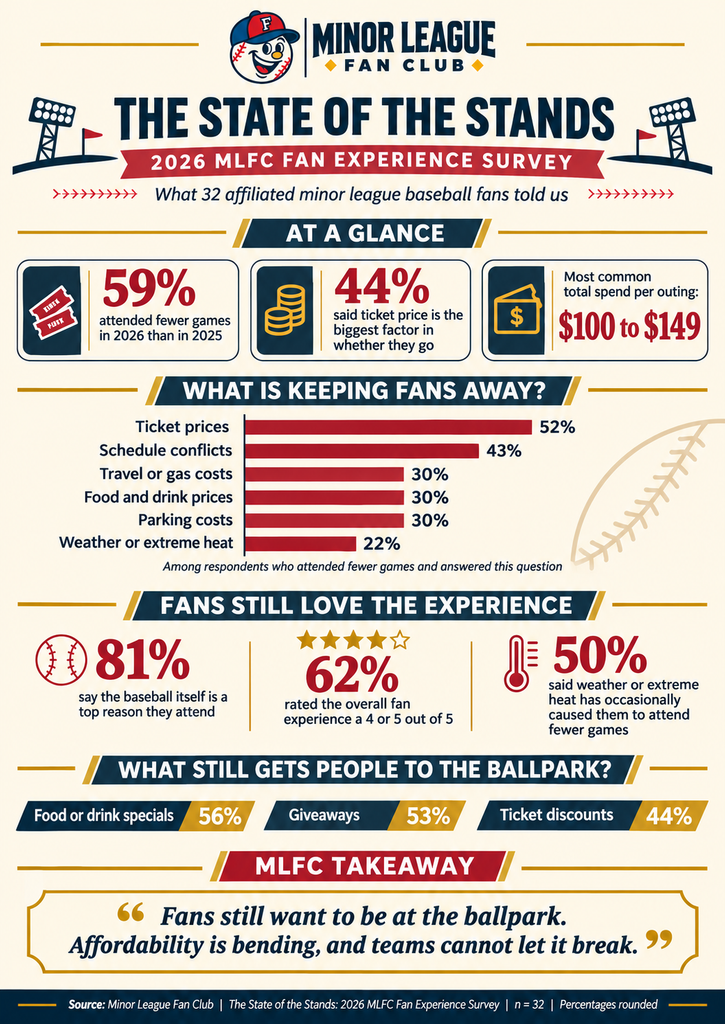
Of the 32 fans who responded to the first State of the Stands survey, 19 said they attended fewer affiliated Minor League Baseball games in 2026 than they did in 2025.
When asked what influenced that decline, ticket prices were the most common answer.
And when asked which individual cost had the biggest impact on whether someone attended a game, tickets finished first again.
That made me think about my own experience.
I’m a partial season-ticket holder, so most of the year I’m insulated from what somebody walking up or purchasing online to buy individual ticket sees.
But when I do need another ticket, I have a line in my head.
I really don’t want to pay more than $20 to get into a Minor League Baseball game.
Apparently, I’m not alone.
The ticket is only the beginning
The problem is that nobody goes to the ballpark and buys only a ticket.
At least I don’t.
I want to watch baseball. I also want something to eat and probably a drink.
For me, that alone can easily turn into a $60 night.
Want dessert afterward? Add another $8 or $10.
Now we’re talking about roughly $70 for one person before I even walk into the team store.
And I’ve personally cut back there too. Hats that I remember being able to buy two of for around $60 now routinely make me decide whether I want to spend close to $50 on one (I don’t).
That doesn’t mean teams shouldn’t make money.
Of course they should.
But at some point every additional charge changes the way a fan calculates whether the night is worth it.
One respondent put it better than I could:
“I’m not attending an MLB game so I don’t want to pay MLB prices.”
Another said Minor League tickets in their area had reached the point where they could sometimes get upper-deck Major League tickets for about the same price.
Others repeatedly mentioned parking, concessions and fees.
One answer specifically called out being charged more for buying a ticket on game day.
Another simply said:
“$10-15 tickets.”
There was a lot of that in these responses.
Not necessarily, “Make everything free.”
More like, remember where we are and who is coming to these games.
Fans still like the experience
Here is where the results get more interesting.
This wasn’t a survey full of people telling us Minor League Baseball is terrible.
Quite the opposite.
Twenty of the 32 respondents rated the overall fan experience a 4 or 5 out of 5.
And when we asked why people attend, the number one answer wasn’t giveaways, theme nights, fireworks or food.
It was baseball itself.
Twenty-six of 32 respondents selected it.
After that came the ballpark atmosphere, socializing with friends and family, supporting the local team and community, promotions, family outings and watching prospects.
That sounds a lot like why I love this level of baseball in the first place.
One respondent described the value as:
“The intimacy, the local connection, the entertainment.”
That is a reason I share regularly when people ask me.
Another talked about going to Reading, Pennsylvania and finding an older ballpark packed with fans, describing strangers connecting with each other and feeling like part of a family.
That’s the magic.
We don’t want to stop coming.
We want more reasons to come.
State of the Stands survey at a glance
Affordability comes before experience
There is always an argument that price matters less if the experience is good enough.
I understand the logic.
I just don’t completely agree with it.
If I can’t afford the ticket, I never get the chance to experience the atmosphere, eat the crazy food item, see the giveaway or decide whether the night was worth what I spent.
For me, affordability has to come first.
And this is where I think teams need to pay especially close attention to their regular fans.
There are diehard fans spending money with these organizations over and over again.
They buy the tickets, the food, the drinks, the parking, the hats, the jerseys, and attend the special events.
If teams want that money then give those people reasons to keep spending it with you.
I had someone who wanted to attend games with us several times this past season. They went online, saw the ticket price and then saw the additional fees.
They balked.
They decided they’d wait.
That is a potential fan who wanted to come to the ballpark and chose not to before ever getting through the gate.
Not every complaint was about money
One result I had almost forgotten about until I read the responses was frustration with the current six-game series format.
I get it.
It gets tiring seeing the same opponent six nights in a row.
Even in the Texas League, where the North and South divisions are made up of teams relatively close to one another, you can spend a huge part of the season seeing the same handful of clubs while barely seeing teams from the other division.
Several respondents specifically asked for the old three- or four-game series format to return.
There were other frustrations too.
Some longtime fans said the product has become stale.
Others thought teams had gone too far with promotions and entertainment.
That’s one place where I disagree with some of the responses.
Minor League Baseball has to promote.
That is part of what makes this level different.
Major League Baseball can rely much more heavily on the game itself and generations of built-in fandom. Minor League clubs have always had to give people another reason to come through the gates.
That might be a ridiculous food item, a bobblehead, fireworks, an alternate identity, something for the kids, or something weird enough to make you text your friend and say, “You have to see this!”
I think teams are actually doing a lot of that well.
Social media has made it easier to put those ideas in front of people. Instagram-worthy food gets people talking. Creative identities get shared around the country.
The issue isn’t that teams are trying too hard to attract people.
The issue is making sure fans can still afford to say yes once they’re interested.
Promotions still have a role
The survey produced an interesting contradiction around promotions.
Promotions and giveaways weren’t especially important overall when we asked fans to rate how much they influence the decision to attend.
But ask which promotions actually get their attention and the picture changes.
Food and drink specials led the responses followed closely by giveaways and ticket discounts.
That tells me promotions may work best when they make the experience feel like a better value.
And then there are alternate identities.
Eighteen of our 32 respondents said an alternate identity, Copa identity, special jersey or themed merchandise had influenced them to attend a game, buy merchandise, or both.
Eight specifically said it influenced a merchandise purchase.
Seven said it influenced both attendance and merchandise.
Only three said attendance alone.
As somebody who pays a lot of attention to Minor League identities and hats, I find that fascinating.
The crazy branding might not always be what gets somebody through the gate.
But it absolutely has the ability to deepen the relationship between a fan and a team.
Weather matters too
Seventeen respondents said weather or extreme heat had caused them to attend fewer games at least occasionally.
Living in Texas, I don’t need much convincing on this one.
One respondent talked about taking their grandchildren to games here and basically said adults might be willing to sit in the heat but kids are another story.
I’ve experienced that one first hand where my own kids wondered if it was “time to go yet.”
Teams can’t control the temperature.
But weather becomes another part of the calculation when a fan is already asking whether the price of the night is worth it.
What I hope teams hear
This was not a massive national survey.
Thirty-two responses should not be treated like the voice of every Minor League Baseball fan in America.
But they came from fans in 15 states, and when you read their answers, certain themes kept showing up.
There are people who love this level of baseball. There are people who want to bring their kids. There are people who want to travel to new ballparks.
There are people who want to buy your hats, eat your food, watch future Major Leaguers and spend summer nights with friends in the stands.
We want to give you our money.
Just don’t make it increasingly difficult for us to do it.
And please remember the regulars.
If somebody attends ten, twenty or forty games a year, figure out how to make that loyalty valuable to them.
If parking is the only realistic option, does it need to be $15?
If a fan buys a pretzel at a concession stand, do we really need to put them in the awkward position of declining a tip prompt because someone grabbed it and handed it across the counter?
If someone decides at 4 p.m. that they want to go to that night’s game, should buying a ticket at the gate cost them more?
Those little things add up.
And eventually they become part of the answer to a much bigger question:
Do I want to go tonight?
Affordability is bending. Let’s not break it.
I still believe Minor League Baseball is one of the best ways to experience baseball.
These responses made me more convinced of that, not less.
People talked about relaxation, community, family, future stars, being close to the field, and finding a temporary escape from everything happening outside the ballpark.
Those are things worth protecting.
But “affordable family entertainment” cannot just be marketing language.
Fans have to actually experience it that way.
The affordability promise isn’t broken yet.
But I think it’s bending.
And if teams want attendance moving in the other direction again, maybe one of the best places to start is listening to the people who are already telling them:
We want to be there. Help make it easier for us to keep coming.
A note about the survey
The inaugural State of the Stands: MLFC Fan Experience Survey received 32 responses from fans in 15 states. Participation was voluntary and respondents were primarily reached through Minor League Fan Club’s audience and social channels. The results represent the experiences and opinions of those respondents and should not be interpreted as a nationally representative survey of all Minor League Baseball fans.