
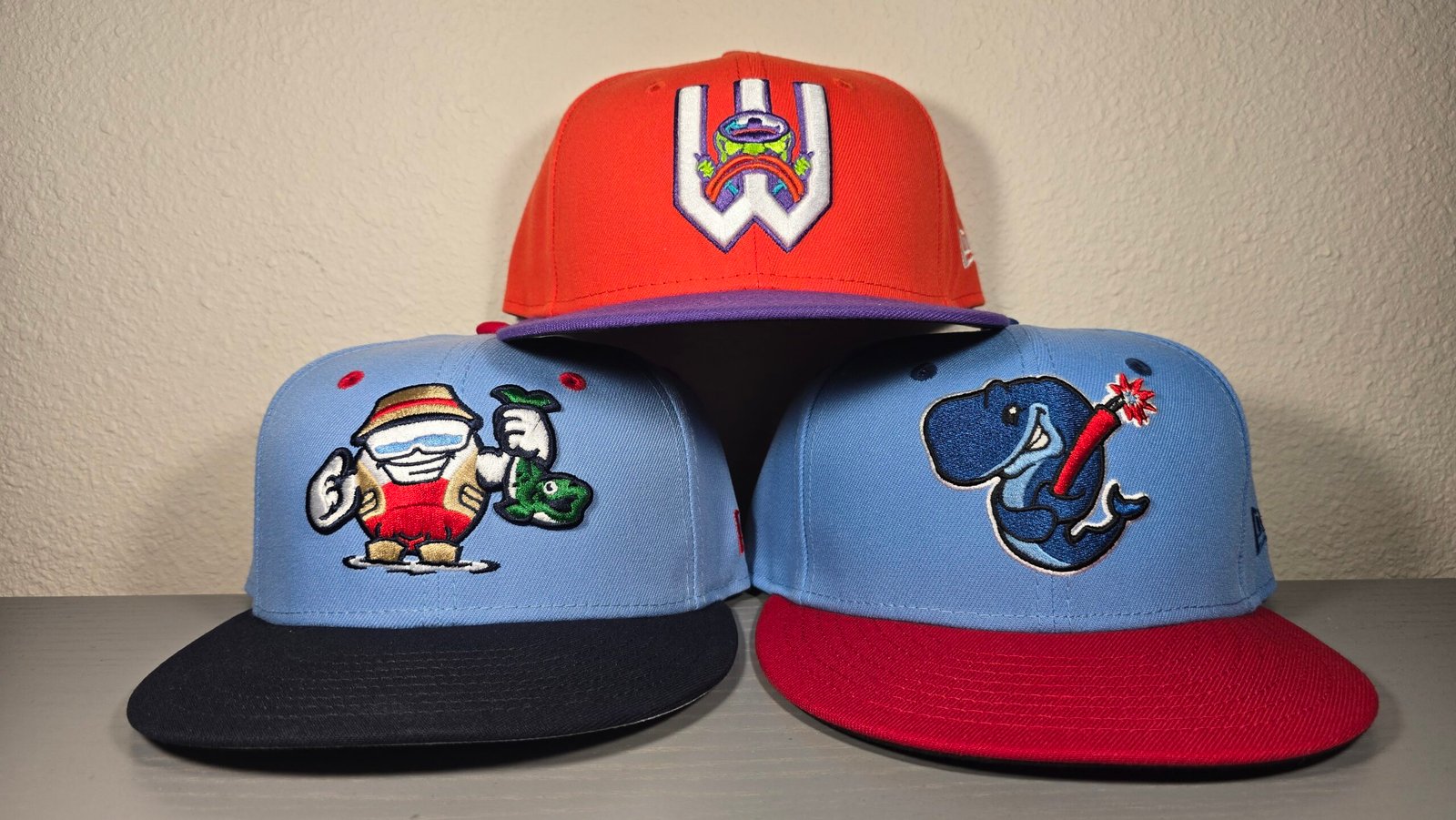
I love alternate identities and when they started becoming a bigger part of Minor League Baseball, I was all for it. If I’m being completely transparent, one of the biggest reasons was pretty simple: more fun logos meant more hats for me to collect. Some of the names were ridiculous but that was part of what made them fun.
As the years passed, though, it started to feel like teams were just trying to one-up each other. The names got stranger, the local connections became more obscure and every new reveal seemed to be searching for something even more outlandish than the last one. I still get excited when a team announces a new identity so I’m nowhere near the point of wanting them to stop. I just don’t think every quirky fact about a city needs to become a logo.
For me, the difference between a great alternate identity and one that feels forced usually comes down to the story behind it. The best ones teach me something about a community, give locals something they recognize and make people from outside the area curious enough to learn more.
When the Story and the Community Connect
The Binghamton Bobbers are a good example og a great community connection and story. Binghamton introduced the identity in 2026 as a tribute to Dick Stack opening the bait-and-tackle shop in the city that eventually became Dick’s Sporting Goods. The fishing theme tie-in makes sense and the logo becomes more than a funny character on a hat. There is attached piece of local history behind it.
That is part of why I like alternate identities. I can see a logo from a place I have never visited, learn about what it means, and get excited for a piece of a community that I probably wouldn’t have learned otherwise.
The Jersey Diners are another example. New Jersey’s diner culture is bigger than Somerset and I think that helps this identity be great. The Patriots built the entire look around something people across the state immediately understand, from the neon colors and coffee cup mascot to the uniforms and overall presentation. Fans really got excited for this alternate identity. The Jersey Diners won MiLB’s Best Alternate Identity award in 2024 and returned for additional games the following season.
Somerset also took the idea beyond simply putting a new logo on merchandise. Jersey Diners games included themed food, music, promotions and partnerships with local diners, which helped make the identity feel like an actual celebration of New Jersey diner culture instead of a weekend costume change. Someone from New Jersey can wear that hat and have an immediate story to tell when another person asks about it.
When an Alternate Becomes Bigger Than the Original Idea
Wichita may be the strongest example of what can happen when fans truly connect with an alternate identity.
The Turbo Tubs began as an alternate look tied to Wichita’s history of the bathtub races held on the Arkansas River. The identity debuted for select games in 2022 but it eventually became popular enough that the organization announced the Wind Surge would permanently become the Wichita Turbo Tubs beginning with the 2027 season.
You probably cannot ask for much better proof that an alternate identity worked. What began as something fun for a handful of games developed enough recognition and community support to become the team’s full-time name.
Nostalgia probably plays a role in that connection, too. People like things that remind them of where they are from, what they grew up around and the stories that belong specifically to their city. When an identity taps into that feeling, it has a much better chance of becoming something fans actually care about instead of another piece of merchandise they might buy once.
Sometimes the Story Is Weird Enough to Carry the Whole Thing
The Eugene Exploding Whales sit right on the edge of what sounds like it should be too ridiculous to work.
In 1970, a dead sperm whale washed ashore near Florence, Oregon. Officials decided dynamite was the best way to dispose of it, and the result became one of the strangest pieces of Oregon history. Decades later, the Eugene Emeralds turned that story into the Exploding Whales alternate identity.
If someone told me a team was going to create a logo around an exploding whale without giving me any context, it would sound exactly like the kind of thing I am questioning in this article. The difference is that Eugene actually had the story to support it.
The Emeralds worked with the city of Florence and community leaders while developing the identity and they also connected the promotion to marine education and conservation efforts. Fans loved it! The first batch of Exploding Whales merchandise reportedly sold out in 90 seconds and the identity became a recurring part of Eugene’s schedule rather than disappearing after one weekend.
That’s why I think this one is worth mentioning here. The shock value gets people to look but there is enough history and community connection behind it to keep the idea interesting after the joke wears off. And if you’ve never watched the video of this happening then click the link above to see the disaster of a demolition.
Where Alternate Identities Start Losing Me
A local connection by itself does not automatically make something a strong identity either.
The Lehigh Valley IronPigs played as the Lehigh Valley Traffic in 2025 as part of their annual Salute to Lehigh Valley promotion. The idea came from something residents obviously understand: traffic in the region, particularly the frustration surrounding local roads like Route 22.
I understand the joke and I understand why people from the area might laugh at it and relate. It just does not connect with me the same way the Bobbers, Jersey Diners or Turbo Tubs do because traffic is hardly unique to Lehigh Valley.
That is where I think the distinction becomes important. Almost every city has traffic, strange laws, foods people argue about and odd things that happened at some point in its history. If you work backward long enough, almost anything can technically be connected to a community.
The better question is whether people from that community actually identify with it.
There is a difference between saying, “this happened here,” and saying, “this is part of who we are.” The strongest alternate identities usually fall into the second category.
The Merch Question
Merchandise is obviously part of the equation and I am certainly not going to criticize teams simply for wanting to sell more of it. I am one of the people buying the merch.
Minor League Baseball teams are businesses and alternate identities give fans another reason to buy something they may not have purchased otherwise. The Jersey Diners are a perfect example of how successful that can be. According to the Patriots, Diners merchandise accounted for 37.5 percent of the team’s merchandise sales during its debut season, while overall retail sales increased significantly.
My concern comes when the process appears to start with the merchandise instead of the story.
There is a meaningful difference between asking what part of a community deserves to be celebrated and asking what local reference can be turned into a logo that might sell hats. Sometimes those two things lead to the same place but not always.
You can usually tell when an identity has something behind it because fans continue talking about it after the reveal. Teams brings it back, promotions grow around it, and locals start identifying with it. When an alternate identity appears for one weekend and ends up heavily discounted in the team store at the end of the season, I start wondering whether there was enough of a connection there in the first place.
Maybe Teams Should Let the Good Ones Breathe
I do not think Minor League Baseball has too many alternate identities overall. I do think some teams try to introduce too many within the same season.
If an organization spends months developing a strong concept, designing an entire logo suite and creating merchandise around it, I would rather see that identity get enough time for fans to actually connect with it. A few appearances throughout the season give people a chance to experience the theme at the ballpark, recognize the character and eventually associate it with the team.
Somerset expanded the Jersey Diners schedule after its first season and added a mascot and additional logos. Eugene turned the Exploding Whales into a recurring identity. Wichita eventually made the Turbo Tubs permanent. Those examples feel less like temporary merchandise campaigns and more like brands that were allowed to develop.
Not every alternate identity needs to reach that level but I would rather see teams create one or two strong ideas and give them room to grow than constantly move on to the next reveal.
The Weirdness Is Still Part of What Makes MiLB Fun
None of this means I want Minor League Baseball to stop being weird. The strange names, ridiculous mascots, food identities and promotions that probably would never happen in Major League Baseball are a huge part of what makes the experience different. It’s why there is a Minor League Fan Club in the first place.
I still enjoy seeing new identities announced and I will more than likely keep buying more hats than I need. I just think the best concepts have something underneath the weirdness. There is a local story worth telling, a design somebody clearly spent time thinking through and a connection strong enough that residents are proud to explain what the logo means when somebody asks about it.
So, are alternate identities getting out of hand? I do not think so.
The bigger concern is whether the race to create the next strange name or viral logo sometimes moves faster than the thought that should go into making one meaningful.
Weird can get somebody’s attention. A great story is what makes the identity worth remembering.